


Cyber Security Awareness Month 2026: 9 Tips From Our Leaders
Marking Cyber Security Awareness Month With Practical Advice From the People Protecting Organisations Every Day
Cyber Security Awareness Month is here, and this year’s theme from the National Cybersecurity Alliance is ‘Don’t Make It Easy for Them’. It’s a good line, and a better principle. Most successful attacks don’t hinge on sophisticated exploits, they hinge on the small doors organisations leave open. This October, I asked each member of the CyberLab leadership team for one thing UK businesses should be doing to close those doors. Here are their nine tips.
The picture in 2026 is not softening. Ransomware payments have shifted, but recovery costs are up. AI is compressing the time attackers need to move through a network. The UK Cyber Security and Resilience Bill is bringing new obligations for supply-chain risk and incident reporting. And the gap between the businesses that recover quickly from an attack and the ones that spend months catching up is almost always down to what was done before the attack, not during it.
Nine tips, one from each of us, in the order I’d take action on them.
1. Make Cyber a Board Discipline
My tip, and the one I’d start with, is to make cyber security a proper board discipline.
If cyber security sits below the top three risks on your board agenda, you are already exposed. The threat trajectory, the regulatory shift, and the operational cost of a serious incident all point in the same direction. Boards that treat cyber as an operational line item, rather than a strategic risk, keep being surprised by what shows up on their doorstep.
Two things belong on the board pack every month. An honest read of your organisation’s cyber security exposure. And a plan that stands up to the pace the threat landscape is moving at. Both need to be in a language non-technical directors can act on.
The businesses I speak to that have made this shift are the ones already treating cyber testing, board reporting and incident readiness as standing agenda items. If you’re still bolting it onto the end of an operations update, that’s a change worth making this Cyber Security Awareness Month.

2. Get Cyber Essentials Certified
Sandra’s tip goes to the baseline that closes the door on most of what actually lands.
Cyber Essentials is the UK’s government-backed baseline set of controls. It covers multi-factor authentication, secure configuration, patching, malware protection and access management, the five areas that show up in most breaches. If you meet the standard, most opportunistic attackers move on to a softer target.
Two things are worth acting on this month. If you already hold Cyber Essentials on the old Willow question set, you have until 26 October to complete your renewal before it retires. Miss it, and your next assessment moves to Danzell, which is tighter across MFA, cloud, and board-level compliance declarations.
If you’re not certified yet, use October as the deadline you needed. As an IASME-approved certification body, CyberLab has issued over 1,500 Cyber Essentials and Cyber Essentials Plus certificates to UK organisations. The process is faster than most compliance leads expect.

3. Read Your Cyber Insurance Policy
Tom’s tip is the one most CFOs regret not taking sooner.
The policy you think you have is not always the cover you actually have. War and nation-state exclusions are broader than most policyholders realise. Known, unpatched vulnerabilities are frequently cited as grounds for claim rejection. Failure to maintain the security controls stated at renewal can void a claim mid-incident.
There is also a direct financial upside to documented controls. UK SMEs in the £1m to £10m revenue bracket see cyber insurance premiums range from £1,500 to £9,000, and the gap is largely explained by what a business can evidence. MFA, EDR, patching cadence, incident response readiness. If you can prove the controls, your premium goes down. If you can’t, they don’t count at renewal.
Cyber insurance is a financial discipline, not a purchase. On 7 October, CyberLab is hosting a webinar with Beazley and Capsule Insurance to unpack how insurers actually respond when a claim comes in.


4. Pen Test Your External Attack Surface
Wayne sees the pattern across every UK organisation CyberLab tests.
We deliver over 14,000 hours of penetration testing every year, and the finding is the same. What attackers can see is often not what internal teams think they can see. Old subdomains still resolve. Forgotten dev environments still respond. Third-party services return more than they should. The controls sit inside the perimeter. The exposure sits outside it.
If you have not tested your external attack surface in the last twelve months, you are not testing recently enough. Threats and exposed assets change faster than an annual scan can catch. Continuous external testing, or at minimum a full annual pen test paired with monthly automated attack surface monitoring, gives you the same view the attacker has.
CyberLab is CREST and CHECK accredited, and every consultant on the pen testing team holds those credentials personally. Testing where the attacker looks, not where you’re comfortable, changes what you find.

5. Automate Your Patching
Jim’s tip is the boring one that stops most of what actually lands.
Exploited vulnerabilities remain the top technical root cause of ransomware attacks in the UK, per the Sophos State of Ransomware 2026 report. And most of the time, the fix already existed. Nobody applied it in time.
Manual patching does not scale. Between the CVEs published each week, the third-party libraries, the shadow assets nobody remembers, and the operational risk of applying patches without testing, keeping up by hand is a losing game. Automated patch management closes the window between disclosure and exposure, and it removes the single point of failure that a manual process depends on: a human remembering.
If your patching cadence relies on a person remembering to apply Tuesday’s Windows updates on Wednesday, that cadence is not fast enough for the threat landscape you’re operating in. Tools like Vicarius vRx run vulnerability discovery, prioritisation and remediation continuously.

6. MFA on Every Account That Needs It
Chris hears the same pattern in new-business conversations, again and again.
Organisations say they have multi-factor authentication. What they mean is they have MFA on some accounts. Admin accounts, sometimes. Legacy systems, rarely. Service accounts, almost never. Third-party integrations, forgotten.
Compromised credentials remain one of the top root causes of ransomware attacks affecting UK businesses. If MFA is on every account that touches your data, the credential doesn’t get the attacker in. If it’s on some accounts, they walk around the ones without it.
Audit where MFA is enabled, and where it isn’t. Every SaaS platform, every legacy application, every service account, every integration. The gap is where the risk lives, and it’s usually much wider than IT teams initially think. Cyber Essentials Danzell now makes not enabling MFA where it’s available an automatic fail, which is a good forcing function for organisations still auditing their coverage.

7. See What an Attacker Sees
Ric’s tip picks up where Wayne’s ends, on the continuous side.
Most security tools look inward. They monitor what’s inside your network, your identity system, your endpoints. All of that matters. But it doesn’t show you what an attacker actually sees when they look at your business from the outside, which is where their reconnaissance starts.
Exposed subdomains. Leaked credentials on the dark web. Certificates expiring on public services. Third-party services you no longer remember exposing you. Continuous outside-in monitoring closes that gap. Not an annual snapshot. Every night. So when something changes on your perimeter, you know before the attacker does.
HackRisk is CyberLab’s continuous outside-in attack surface monitoring product, and it now brings dark web scanning, vulnerability scanning, reconnaissance and asset discovery, supply chain risk, and phishing simulation and awareness training into one platform. AI-generated remediation guidance means users get actionable next steps, not just a CVE number.

8. Tabletop Your Incident Response
Adam takes a lot of calls from prospects who’ve just had an incident. They always start the same way.
“We didn’t think it would happen to us. And then, we didn’t know what to do first.”
Tabletop exercises are the calm before the crisis. They walk your board and your response team through a realistic scenario. One hour. No systems down. And they surface every gap in your plan. Who calls the ICO. Who talks to customers. Who decides whether to pay a ransom. Who’s on holiday. Which supplier holds the backup. Whether your incident response retainer covers what you think it covers.
The businesses that recover fastest from a cyber incident are almost always the ones that practised. The ones that spend weeks catching up are the ones who assumed a plan on paper was enough. A tabletop exercise costs a few hours of leadership time and pays back in every hour of downtime it prevents.

9. Train Your People Like You Train Your Systems
Mimi’s tip is the one that quietly changes the odds most.
Culture isn’t a poster on the wall, and cyber security isn’t a policy in a folder. Both are built by the same thing. Small, consistent actions, taken by people who understand why.
Phishing simulations. Security awareness training. Making it easy for someone to flag a suspicious email without feeling silly. Repeating the training often enough that it becomes muscle memory, not a once-a-year tick-box. These are the daily habits that turn the biggest attack surface, your people, into the strongest one.
At CyberLab, cyber security awareness is part of how we work, not something we wheel out in October. It’s built into onboarding, refreshed monthly, and reinforced through simulated phishing that treats being caught as a learning moment, not a punishment. The result is a team that flags suspicious activity because it’s easy to, not because they’ve been told they have to.

How CyberLab Supports Cyber Security Awareness Month
Cyber Security Awareness Month is a month, but the tips above are a year-round discipline. CyberLab supports UK organisations across every one of them.
- We are an IASME-approved certification body for Cyber Essentials and Cyber Essentials Plus, with over 1,500 certificates issued.
- We are CREST and CHECK accredited for penetration testing, red teaming and web application security testing.
- We deliver tabletop exercises, incident response retainers and Sophos MDR for organisations that want the response side sorted before an incident happens.
- HackRisk gives you continuous outside-in visibility of your attack surface, plus phishing simulation and security awareness training in one platform.
- Our consultancy team works alongside boards and finance functions to translate technical risk into decisions non-technical leaders can act on.

CyberLab Partners with CYFOR Secure for Expert Incident Response
CYFOR Secure: CyberLab's New Incident Response Partner
When a cyber attack hits, the difference between a contained incident and a catastrophic one is measured in minutes, not days. That’s why I’m pleased to announce that CyberLab has partnered with CYFOR Secure, a UK-based, ISO 27001, ISO 9001 and ISO 14001 accredited cyber security specialist, to deliver expert-led Incident Response to our customers around the clock.
This partnership means that when a CyberLab customer calls our Incident Response number, they’re connected directly to CYFOR Secure‘s 24/7 Incident Response Hotline, putting experienced responders on the case within moments of the call being answered. CyberLab remains the customer’s main point of contact throughout, while CYFOR Secure’s specialists work behind the scenes to triage, contain and resolve the incident.
Why We Chose CYFOR Secure
Choosing an Incident Response partner is not a decision we took lightly. Every organisation we work with needs to know that if the worst happens, the people picking up the phone have done this before, at scale, under pressure.
CYFOR Secure brings exactly that. Beyond incident response, their team provides digital forensics and expert witness services across the UK, giving them a depth of casework and courtroom-tested rigour that few providers can match. Their accreditations across ISO 27001, ISO 9001 and ISO 14001 reflect the same standard of operational discipline we hold ourselves to at CyberLab.
What This Means for CyberLab Customers
Whether an organisation is dealing with ransomware, a data breach, a business email compromise or an advanced persistent threat, this partnership gives them a clear route to specialist help without having to source and vet a provider mid-incident:
- Immediate hotline access. One call to CyberLab’s Incident Response number connects customers straight through to CYFOR Secure’s Incident Response Hotline, so triage begins without delay.
- Expert-led containment. CYFOR Secure’s responders isolate affected systems, preserve forensic evidence, and stabilise the environment, while CyberLab keeps customers informed at every stage.
- Incident Response Retainers. Organisations that want guaranteed priority access and faster response times before an incident occurs can now take out a retainer through CyberLab, backed by CYFOR Secure’s readiness model.
“Incident response is one of those areas where speed and trust have to work together. Our customers don’t want to be vetting a new provider while they’re mid-attack, they want a number to call that they already trust. Partnering with CYFOR Secure gives us a response capability that matches the pace of the threats we’re seeing, without adding a single extra step for the customer.”
– Wayne Price, Commercial Director, CyberLab

A Response Built for How Attacks Actually Happen Today
The threat landscape has shifted. Attackers are moving faster, extortion increasingly happens without ransomware ever being deployed, and the window between initial compromise and full impact is shrinking. The NCSC’s own guidance on incident management is clear that preparation and rapid, decisive action are what separate a manageable incident from a damaging one.
That is precisely the gap this partnership closes. Rather than customers needing to find and brief a specialist responder while an attack is actively unfolding, CyberLab and CYFOR Secure give them a single number to call and a response that starts immediately.
How CyberLab Supports Incident Response
- We connect customers directly to CYFOR Secure’s 24/7 Incident Response Hotline.
- We remain the main point of contact throughout, coordinating communication and next steps.
- We offer flexible service models, from ad hoc response to fully retained cover.
- We combine this partnership with our wider CREST, CHECK and NCSC-accredited service portfolio, so incident response sits alongside prevention, detection and compliance support.
Get Ready Before You Need To Be
The organisations that recover fastest from a cyber attack are almost always the ones that had a plan in place before it happened. This partnership with CYFOR Secure gives CyberLab customers a faster, more capable route to expert help the moment they need it.
CyberLab is a CREST-, CHECK- and NCSC-accredited cyber security partner trusted by 1,200+ UK organisations. To find out more about our Incident Response service models, or to discuss an Incident Response Retainer, get in touch with our team today.

AI, Risk and Regulation: Three Conversations Cyber Leaders Need to Have in 2026
Ahead of SecureTour 2026, CyberLab unpacks the three cyber security conversations that belong at the top of every senior leader's agenda this year.
The cyber security landscape has shifted faster in the last eighteen months than in the previous five years combined. AI has changed how attackers move and how defenders must respond. The regulatory framework governing UK organisations is being rewritten. And the pressure on the people responsible for cyber security – from CISOs to boards – has never been greater.
This September, CyberLab is bringing senior leaders together across five UK cities to work through all of it. Before we get to that, here is what the data is telling us right now.
The AI Threat Shift is Already Underway
For years, the industry warned that artificial intelligence would transform the threat landscape. In 2026, that transformation is no longer theoretical.
Darktrace’s State of AI Cybersecurity report found that 87% of security professionals are seeing more AI-driven threats than twelve months ago. Around half cite AI-powered phishing among their top concerns – a threat backed by growing evidence that AI is now routinely used to craft convincing, personalised attacks at scale. The volume of convincing, personalised attacks organisations face today simply could not have been generated at scale without AI.
Speed is changing too. CrowdStrike‘s 2026 Global Threat Report found that the average time for an attacker to move laterally across a network after gaining initial access has dropped to just 29 minutes – a 65% increase in pace compared to 2024. When a breach can escalate that quickly, detection and response times that would have seemed adequate last year may no longer be enough.
94% of organisations surveyed say AI is the biggest cyber security force shaping the year ahead. Darktrace’s 2026 State of AI Cybersecurity report adds that nearly half of security professionals do not feel adequately prepared to defend against AI-powered attacks.
The implication is clear. AI has fundamentally changed the cost and capability available to attackers. The organisations that recognise this and adjust their posture accordingly are the ones that will be better placed to manage the risk.
Cyber Leadership Has Never Been More Complex
Ask a CISO what keeps them awake at night in 2026 and the answer goes well beyond the threat landscape. Budget pressure, board expectations, team exhaustion and the challenge of communicating technical risk to non-technical decision makers have all intensified in the last twelve months.
Proofpoint’s 2025 Voice of the CISO report found that 63% of CISOs have experienced or witnessed team burnout in the past year. Behind that number is a familiar pattern: as threat volume increases, so does the pressure on the people managing it. An organisation that claims strong cyber resilience on paper while quietly exhausting its security team is carrying a risk that rarely shows up in a dashboard.
At board level, the challenge sits at a different altitude. CISOs and senior security leaders are increasingly expected to translate complex technical exposure into language that boards can act on – operational impact, financial consequence, reputational risk. Getting that translation right, while also leading a team and staying ahead of an evolving threat landscape, is one of the most demanding briefs in any organisation right now.
There is also the question of AI governance. As organisations deploy AI tools internally, the security implications multiply. Who owns the risk when a large language model is trained on sensitive data? What does responsible AI use look like in a regulated environment? These questions land on the desk of the security leader, often before an organisational policy exists to guide the answer.

Discuss AI, Risk and Regulation with Senior Leaders at SecureTour 2026
If AI threats, board expectations and the incoming regulatory shift are on your agenda this year, SecureTour 2026 was built for you. Five cities, one morning each, and a room full of the right people.
CyberLab is a CREST- and CHECK-certified cyber security consultancy, an NCSC Cyber Advisor and Cyber Essentials certification body. Every session at SecureTour is grounded in what is actually working in the field.
Regulation is Catching Up. Fast.
For UK organisations, the regulatory picture is changing significantly. The UK Cyber Security and Resilience Bill, introduced to Parliament in November 2025, modernises the Network and Information Systems Regulations 2018 and substantially expands the scope of organisations required to meet formal cyber security obligations. With Royal Assent expected in late 2026 and phased implementation running into 2028, the planning window is shorter than it might appear.
The Bill introduces a two-stage incident reporting requirement: an initial notification within 24 hours, followed by a full report within 72 hours. Penalties for non-compliance reach up to £17 million or 4% of worldwide turnover, whichever is greater. And in a significant shift, the obligations extend into the supply chain, meaning your third-party risk posture is no longer just an operational consideration but a regulatory one.
For organisations with European operations, the overlap between the new UK framework and the EU’s NIS2 Directive adds another layer of complexity. Navigating both, with different requirements and different timelines, is fast becoming one of the most demanding compliance challenges in the sector.
These Conversations Are More Valuable in the Room
Reading about AI threats, board communication and incoming regulation as separate challenges is useful. But the most actionable insight comes from peers who are navigating the same complexity you are, in organisations of comparable size and sector, making the same resource calls and facing the same trade-offs.
That is the premise behind SecureTour 2026, CyberLab‘s annual cyber security roadshow.
SecureTour 2026
Not a vendor showcase. Not a conference circuit keynote. A structured half-day in a city near you, where the people accountable for cyber risk sit together, hear from experts grounded in real-world UK deployments and test their thinking against people who understand the context.
The three sessions at SecureTour map directly to everything above.
-
AI Threats in Action: A live AI-powered attack demonstration, showing exactly how today’s adversaries think and move. Delivered in partnership with Sophos, Proofpoint, Vicarius and Island.
-
Cyber Leadership and Strategy: A peer roundtable for CISOs, Heads of Cyber Security and senior risk leaders. How do you shape strategy that boards can act on? How do you lead with confidence when the requirements keep shifting?
-
Risk, Resilience and Regulation: Expert-led session covering the UK Cyber Security and Resilience Bill, third-party risk management and building operational resilience that holds up under pressure. Delivered in partnership with Chess.
SecureTour 2026 stops at five UK cities this September:
-
Belfast: Europa Hotel – 8 September
-
London: HMS Belfast – 10 September
-
Manchester: IWM North – 15 September
-
Glasgow: Collectors Hall – 22 September
-
Duxford: IWM Duxford – 29 September
Free to attend. Lunch included. Wrapped up by 2pm.
How CyberLab Supports Senior Leaders Navigating These Challenges
CyberLab is a CREST- and CHECK-certified cyber security consultancy, an NCSC Cyber Advisor and Cyber Essentials certification body trusted by over 1,200 UK organisations, including more than 60 NHS Trusts. We work with senior leaders at the intersection of strategy and operational security, helping organisations understand their risk exposure, meet regulatory requirements and build the kind of defence posture that holds up when it matters.
-
We deliver penetration testing, red teaming and attack surface monitoring through HackRisk, giving organisations a clear, tested view of their external exposure
-
Our compliance team supports organisations through Cyber Essentials, ISO 27001 preparation, IASME Cyber Assurance and readiness for incoming regulatory frameworks including the Cyber Security and Resilience Bill
-
Our consultancy team works with CISOs and board-level stakeholders to translate technical risk into language that drives strategic decisions
-
We partner with Sophos, Proofpoint, Microsoft, Keyfactor, Vicarius and others to bring best-in-class technology alongside our consulting expertise
Save Your Seat at SecureTour 2026
If AI threats, board expectations and the incoming regulatory shift are on your agenda this year, SecureTour 2026 was built for you. Five cities, one morning each, and a room full of the right people.
CyberLab is a CREST- and CHECK-certified cyber security consultancy, an NCSC Cyber Advisor and Cyber Essentials certification body with over 30 years of combined expertise, trusted by more than 1,200 UK organisations. Every session at SecureTour is grounded in what is actually working in the field.

Why Cyber Security Testing Now Belongs in the Boardroom
A practical guide for executives on building a penetration testing programme that boards, customers and insurers can trust.
October is Cyber Security Awareness Month. It’s a good time to check whether your leadership team can answer four simple questions about security testing.
Cyber security used to start and finish with the IT director. Now it turns up in the board pack, the customer questionnaire and the insurance renewal. When something goes wrong, it’s the chair, the CEO or the CFO who gets asked why.
We see this across the 1,200+ UK organisations we work with. As a CEO who reports to a board, I recognise it too. The leadership teams who handle it well treat cyber as a business risk they own, and they can back up what they say with evidence.
Why It’s on the Board Agenda
The board. Boards have seen it happen. The Government’s Cyber Security Breaches Survey 2025/26 found that 69% of large and 65% of medium-sized UK businesses had a breach or attack in the past 12 months. Many directors have been through one or watched a peer go through one, and they’re asking harder questions.
Customers. Customers want proof. Verizon’s 2025 Data Breach Investigations Report found third-party involvement in breaches doubled in a year, from 15% to 30%. Supplier questionnaires now ask who tested you, when, to what standard and what you fixed. A vague answer slows the deal down, and sometimes loses it.
Cyber insurers. Insurers want evidence on day one. We’re seeing renewals that used to take a fortnight now take six weeks when the evidence isn’t ready. Through our partnership with Capsule, the same evidence can also lower your premium.
AI adoption. Then there’s AI. If your business hasn’t formally adopted it, your suppliers probably have, and some of your staff are likely using tools nobody approved. That needs a policy, approved tools, testing and training, with someone senior who owns it.
Compliance requirements. And regulation is tightening. Since April 2026, the Cyber Essentials declaration, signed by a board member or director, commits the organisation to maintaining every control for the full certification period. The Cyber Security and Resilience Bill, now at committee stage in the House of Lords, will add tighter incident reporting and stronger enforcement.
Reduce your cyber insurance premium with CyberLab and Capsule.
Through our partnership, the evidence from your security testing can convert directly into savings on your premium.
Speak to us to find out how much you could save.
Four Questions to Answer
The fix is simpler than it sounds. You and your executive team should be able to answer these four questions, with evidence:
- When was our last independent penetration test?
- Who did it, and to what standard?
- What did they find, and what have we fixed?
- What are we doing differently this year as a result?
If you can answer all four, you’re in a strong position. If you can’t, the gap is usually smaller than it feels. Close it before it becomes a board paper or a lost deal.
What Good Penetration Testing Looks Like
Good testing is planned around your risks and spread across the year. Use an accredited tester: CREST and CHECK are the standards I’d ask for. Findings should be ranked by business impact, with a clear plan to fix them.
That last point matters. Edgescan’s 2025 Vulnerability Statistics Report found 45% of vulnerabilities in large enterprises were still unpatched after 12 months, and 17% of those were high or critical. In my experience the reason is usually simple: nobody turned the finding into a business risk that someone owned.
The CyberLab Difference
That’s where we put our effort. After every test, our consultants sit down with your team in a report review session. We go through the findings and agree what to fix first, based on how your systems are built, what data is at risk and where you are with compliance. Something that looks critical on paper may matter less in your environment, and the reverse is also true.
How We Structure a Programme
One test is a snapshot. A test in January tells you nothing about the API your developers release in June, or a critical vulnerability disclosed in September. So we help clients plan a year of testing, for example infrastructure, web application and social engineering, timed around their risks, compliance deadlines and budget. We agree scope and cadence up front, usually quarterly or twice a year, and review progress at each stage.
Success in Action
Moat Homes, a South East housing association managing more than 20,000 homes, took this approach. Its internal IT team couldn’t watch for threats around the clock, so it combined penetration testing with Sophos MDR and our wraparound support.
Podcast: Hacking Critical Infrastructure Explained with CyberLab
This episode puts the boardroom questions above into practice. Adam Myers sits down with Steve Clarke, Head of Penetration Testing at CyberLab, to explore what proper testing looks like when the systems involved keep the lights on, the water running and the trains moving, and why evidence of what was found and fixed matters even more when the risk is physical, not just financial.
Speak to an Expert
We’ve worked with more than 1,200 UK organisations on this. As a CREST-, CHECK- and NCSC-accredited cyber security consultancy and managed service provider, we deliver penetration testing programmes built for the audiences they need to serve: your board, your customers, your insurers, and your own technology team.
If the questions in this article are ones you’d rather be ahead of than behind, speak to one of our penetration testing experts to get a clearer view of where your cyber security posture is, and how to build a security testing programme that meets the needs of your business.

Cyber Security for CEOs: What Every Business Leader Needs to Know
David Pollock, Executive Chairman at CyberLab, on the cyber threat every business leader needs to take personally.
Most UK business leaders are not technologists. They are decision makers. With more than 30 years of experience leading technology businesses, David knows this better than most. And his view is clear: because cyber security can feel like a technical specialism, it drifts to the IT team’s desk rather than staying firmly on the board agenda. That has to change.
Recently, David sat down with CyberLab’s Sales Director Adam Myers to share what 30 years of building, buying, and leading businesses has taught him about cyber risk. His view is direct: cyber security is the single biggest threat.
Cyber Security is Your Number One Risk
The average data breach now costs a UK business £3.29 million, according to IBM’s 2025 Cost of a Data Breach Report. David does not treat that as a vendor statistic. It sits at number one on his personal risk register. He said:
“If you’re a chief exec running any company and cyber security is not number one on your risk list, you’re in danger of losing your job and, more importantly, losing the jobs of all your people.”
The DSIT Cyber Security Breaches Survey shows that 43% of UK businesses experienced a cyber security breach or attack in the last 12 months, yet many boards still treat it as an IT matter rather than a leadership priority.
As NCSC Chief Executive Richard Horne has stated: “Board members have a critical role in ensuring their organisations are able to exploit the opportunities that technology brings in such a way that they build a resilient and secure business.”
Cyber security belongs on the board agenda every single month. If it is not there, the organisation is carrying a risk that could end it.
Why Executives Are the Highest-value Target in Your Organisation
Senior leaders are not incidentally exposed to cyber risk. They are deliberately sought out.
Board members, NEDs and executives carry access to sensitive commercial plans, M&A data, strategic decisions, and wire transfer authority. NEDs operating across multiple companies expand that exposure still further. Criminals understand this and use publicly available information to build detailed profiles before making first contact.
The attack surface for a typical senior leader spans three dimensions:
- Professional: LinkedIn profiles, Companies House records, board bios, event appearances, conference talks, and media interviews. Every public appearance reveals seniority, relationships, and business context. It also provides voice and facial data that AI tools can use to create convincing impersonations.
- Personal: Family members as pivot points – children visible on Instagram, a spouse’s public profile. Information that builds a fuller picture and creates leverage.
- Physical: Home address exposure through property records, electoral roll entries, and domain registration data.
Before you can manage your executive risk exposure, it helps to know what is already out there. HackRisk is CyberLab’s external attack surface monitoring platform. It scans your public-facing assets, monitors the dark web for exposed business credentials, and identifies vulnerabilities across your digital estate – delivered as a board-ready report with a risk score and remediation advice.
When the Chairman Got Caught: What a Phishing Simulation Revealed
David Pollock knows executive vulnerability first-hand. His security team ran a phishing simulation within his own business, sending an email designed to look like a post-Christmas party message from his colleagues. David clicked it.
“I was on the phone immediately going, ‘they’ve got me’,” and they went, ‘don’t worry, we’ve got three layers of security, we can protect you’.”
Two things stand out in that story. First: if the Chairman of a cyber security company can be caught in a controlled simulation, any executive can be caught in a real attack. Second: what made the difference was not just the layered technical defences. It was the culture of transparency. David reported it immediately, and the right systems were in place to contain the damage.
This is precisely why regular phishing simulations matter. They are not designed to embarrass people. They build the muscle memory of recognising and reporting suspicious communications before a real attacker uses the same technique.
“It is the first line of defence in protecting your organisation, teaching your people not to get caught. We all get caught. But the more you are trained, the better your defences become.”
How AI Has Changed Executive Impersonation
Phishing emails are only part of the picture. AI has made the threat to senior leaders significantly more dangerous by enabling attacks that were not possible even two years ago.
Voice cloning now requires as little as three seconds of audio – the kind that is readily available from a conference talk, a podcast appearance, or a LinkedIn video. Voice cloning fraud increased by 700% between 2024 and 2025 (Source: CallerCheck). The average loss per victim is £11,000. In one documented UK energy sector case, a company lost £200,000 to a deepfake audio attack.
The landmark case is Arup (2024). A finance employee received an email from someone purporting to be the UK-based CFO, requesting a series of confidential transactions. Initially suspicious, the employee felt reassured after joining a video call where the CFO and several colleagues appeared on screen. They then made 15 transactions totalling $25 million. Every other person on that call was an AI deepfake. (Source: World Economic Forum).
This type of attack falls under the broader category of Business Email Compromise (BEC) and CEO fraud. According to the FBI’s Internet Crime Complaint Centre, BEC fraud has caused more than $50 billion in global losses. Closer to home, the M&S breach of 2025 was confirmed by its CEO as “a consequence of human error” carried out through “social engineering tactics via a third-party supplier” rather than a failure of technical systems.
Most attacks exploit trust, not code. The attack vectors are email, phone or SMS, and social media. AI has made all three harder to detect and easier to execute at scale.
How to Spot CEO Fraud Before It Lands
Knowing the warning signs is the first layer of defence. When a request arrives by email, WhatsApp, Teams, or phone that combines several of the following, stop and verify before acting:
- A senior leader contacts you via an unusual number or method.
- The request is urgent, with a tight deadline.
- The situation is sensitive or confidential: a merger, a tax issue, a late payment, an accounting error.
- A third party is involved.
- You are asked to make an immediate payment or transfer outside normal processes.
- On a video call: limited facial movement, or audio with an unusual tone or rhythm.
The pattern to recognise is: urgency, plus authority, plus an unusual request. That combination should always prompt a call back on a known, separate number before any action is taken.
Practical Steps to Protect Yourself and Your Organisation
The following controls come from CyberLab’s executive security workshops and Sophos threat intelligence guidance. Many are low-cost. All are high-impact.
Personal actions:
- Use a password manager. Password length matters more than complexity – three random words you can remember is an effective approach.
- Enable Multi-Factor Authentication (MFA) on all accounts. Never approve an MFA prompt you did not initiate.
- Use a VPN on personal devices, particularly when travelling or working in public spaces.
- Keep all software updated across personal and work devices.
- Tighten privacy settings on personal social media to reduce your publicly visible attack surface.
Business controls:
- Implement verbal confirmation codes for any wire transfer or unusual payment instruction.
- Require dual authorisation for all financial transactions above a defined threshold.
- Establish a clear protocol: always call back on a known direct number before approving anything out of the ordinary.
- Never bypass financial controls on the basis of urgency, regardless of who appears to be requesting it.
- Train staff on voice cloning and deepfake fraud, not just traditional phishing.
- Run regular phishing simulations so your team develops recognition through practice, not theory.
Find Out What Data is Already Exposed About You
Most executives assume their business’s external exposure is something IT keeps on top of. In most cases, no one is actively checking. Before making contact, criminal groups map your public-facing assets, search for misconfigured systems, and check the dark web for credentials exposed in past breaches – all before a single message is sent.
HackRisk is CyberLab’s external attack surface monitoring platform. It scans your public-facing assets, monitors the dark web for exposed credentials, and identifies vulnerabilities across your digital estate. You receive a board-ready risk report within 24 hours, with a risk score and prioritised remediation advice – so you can see exactly where you are exposed before an attacker does.
How CyberLab Supports Business Leaders on Cyber Security
- We support 1,200+ UK organisations with their cyber security strategy, from foundational controls through to advanced threat detection.
- Our social engineering and phishing simulation programmes are built to change behaviour, not satisfy compliance checklists.
- Our tabletop exercises prepare leadership teams for real scenarios, including deepfake and impersonation attacks on executives.
- Our M365 Security Assessment identifies which controls are active, which are not, and where to focus first across the Microsoft stack.
- Our consultancy team works directly with leadership and board teams to frame cyber risk in business language.
- We are CREST-, CHECK- and NCSC-accredited, with 30+ years of combined expertise and over 1,500 Cyber Essentials and Cyber Essentials Plus certificates issued.
Start the Conversation
Cyber security does not require a technical background. It requires leadership. If you want a clearer picture of your organisation’s risk exposure – or your own personal exposure as a senior leader – CyberLab’s team can help, in plain language and without the jargon.
CyberLab is a CREST-, CHECK- and NCSC-accredited cyber security partner trusted by 1,200+ UK organisations.

How CyberLab Delivered Sophos Taegis MDR to East Lothian Council
Building Modern Security Operations for the Public Sector with Sophos Taegis MDR
Public sector organisations are under unprecedented pressure to defend critical services against an evolving threat landscape, while operating within tight budgets and complex legacy environments. Traditional security operations models often fall short. East Lothian Council partnered with CyberLab to change that.
This success story explores how a leading Scottish local authority modernised its security operations capability with Sophos Taegis Managed Detection and Response (MDR), delivered and supported by CyberLab, to gain 24/7 threat visibility, faster incident response, and the operational predictability that public sector finance and service delivery demand.
Why the Public Sector Is a Prime Target for Cyber Threats
UK public sector organisations remain a high-value target for cyber criminals and nation-state threat actors.
The reasons are well documented:
- They hold vast amounts of sensitive personal data on residents, staff and service users.
- They deliver essential services where downtime has real-world consequences for communities.
- They operate complex digital estates with significant legacy infrastructure.
- They face increasing regulatory expectations under NCSC guidance, the Network and Information Systems Regulations, and sector-specific frameworks.
At the same time, public sector cyber security teams are routinely stretched. Recruiting and retaining specialist security analysts is difficult, particularly in regions outside major commercial hubs. Building a 24/7 internal Security Operations Centre is rarely viable, either operationally or financially. This combination of high target value and limited internal resource makes Managed Detection and Response one of the most effective ways for local authorities to elevate their security posture quickly and sustainably.
About East Lothian Council
East Lothian Council is the Scottish local authority responsible for delivering essential public services across East Lothian, supporting thousands of residents, communities and businesses. As part of its ongoing digital transformation programme, the council operates a growing and increasingly interconnected digital estate, with a clear commitment to maintaining service availability, protecting sensitive information and upholding public trust.
As cyber threats targeting the public sector have grown in sophistication, the council recognised that traditional perimeter-based defences were no longer sufficient. A modern, proactive security operations capability was required to keep pace with the threat landscape and protect the critical services East Lothian residents rely on every day.
The Business Challenge: Visibility, Speed and Operational Readiness
Before partnering with CyberLab, East Lothian Council had a clear set of operational priorities. The council needed to enhance its ability to detect, investigate and respond to cyber threats around the clock, across a diverse and complex IT environment.
The specific challenges were:
- Real-time visibility of malicious activity across the entire digital estate.
- Faster response capability to potential threats, with reduced time from detection to containment.
- Always-on security operations, beyond the working hours of an internal IT team.
- Speed of procurement and implementation, with the ability to assess, procure and deploy an advanced MDR solution within short timescales.
- A partner with deep public sector understanding, capable of supporting rapid deployment without disrupting essential services.
- Predictable total cost of ownership, with clear and consistent budgeting for long-term security operations.
The council needed a solution that elevated its threat monitoring and incident response capability, while respecting the unique operational and financial constraints of a local authority.
Why Sophos Taegis MDR Was the Right Fit for the Public Sector
Working closely with the council’s security and infrastructure team, CyberLab assessed the available Managed Detection and Response options against East Lothian Council’s specific requirements. Sophos Taegis MDR was selected as the foundation for the council’s modernised security operations capability for several reasons.
First, it delivers true 24/7 threat detection, investigation and response. Sophos security analysts work alongside CyberLab’s team to monitor activity continuously, investigate alerts at depth, and contain threats before they escalate. For a local authority that cannot staff an internal SOC around the clock, this is transformative.
Second, Sophos Taegis MDR delivers something traditional SOC and SIEM-based models often fail to provide: budget certainty. Many MDR or SIEM solutions are priced on data ingestion or consumption, leaving organisations exposed to unpredictable costs as activity grows. Taegis MDR offers a predictable total cost of ownership, with no ingestion tuning, no SIEM build complexity, and no surprise charges. For public sector finance teams managing fixed annual budgets, that predictability is essential.
Third, Sophos Taegis integrates broadly with existing security tools, helping the council maximise the value of investments already made and avoid wholesale replacement of working technology.

The CyberLab Approach
CyberLab supported East Lothian Council through every stage of the project, combining technical expertise with a deep understanding of public sector procurement, governance and operational realities.
Rapid Procurement and Proof of Concept
The council operated under a short procurement window. CyberLab accelerated the process through a structured proof of concept, demonstrating Taegis MDR’s capability against the council’s specific environment and use cases. This allowed informed decision-making at pace, without the delays often associated with public sector technology procurement.
Deployment and Configuration
Once selected, CyberLab fully deployed and configured Sophos Taegis MDR across the council’s environment. Integration was tailored to the council’s existing security tools, maximising coverage while avoiding duplication of capability.
Seamless Onboarding
Public sector environments cannot tolerate operational disruption. Schools, social care, planning, refuse collection and dozens of other critical services depend on the digital estate. CyberLab designed the onboarding process to be seamless, transitioning the council into a fully managed MDR operation without interruption to live services.
Ongoing Strategic Support
Beyond deployment, CyberLab continues to provide strategic support and guidance tailored to public sector challenges. The relationship is consultative by design, with CyberLab acting as an extension of the council’s internal security team rather than a transactional vendor.

The Outcome: Greater Confidence, Stronger Defences
The implementation of Sophos Taegis MDR has materially strengthened East Lothian Council’s security operations capability. With real-time threat insights, expert analyst guidance and streamlined incident response, the council can focus on delivering essential services with greater confidence.
The key outcomes the council has realised include:
- Improved threat visibility, providing deeper situational awareness across the digital estate.
- Increased confidence in response capability, supported by expert MDR analysts working 24/7.
- Rapid and effective deployment, enabling operational protection in a short timeframe.
- Reduced operational strain, with CyberLab acting as an extension of internal security staff.
- Proactive vigilance and early threat identification, strengthening the council’s overall security posture.
- Predictable long-term operational costs, providing the budget certainty public sector teams need.
The partnership has enabled East Lothian Council to modernise its approach to security operations and adopt a robust, future-ready MDR foundation that supports a more resilient digital infrastructure for the communities it serves.
In the Council’s Own Words
“East Lothian Council has been working closely with CyberLab to strengthen our security operations capability. Their support in implementing Sophos Taegis as our managed detection and response solution provided significantly improved visibility of threats across our environment and increased confidence in our ability to respond swiftly and effectively.
The procurement process and proof of concept were progressed at an impressive pace, with CyberLab able to facilitate rapid turnaround and accommodate short-notice requirements without disruption. They provide added value through proactive vigilance, consistently practical support, and a genuine understanding of local authority challenges.
CyberLab’s team have been responsive, knowledgeable and easy to work with throughout. Their expertise, combined with the capabilities of the Sophos Taegis MDR platform, has delivered tangible improvements to our overall security posture.”
– Graham Burke, Security and Infrastructure Manager, East Lothian Council
Key Takeaways for Public Sector Leaders
For council CIOs, Heads of IT and security leaders considering how to elevate their security operations:
- MDR removes the need to build an internal SOC, giving public sector teams 24/7 capability without the recruitment burden.
- Predictable pricing matters. Avoid consumption-based MDR models that expose council budgets to unpredictable variance.
- Procurement speed is achievable. With the right partner, even complex MDR deployments can be assessed, procured and operational quickly.
Public sector understanding is essential. Choose a partner who understands legacy environments, service availability constraints, and the realities of local government operations.

How CyberLab Supports the Public Sector
CyberLab works with local authorities, NHS Trusts, central government departments and public sector institutions across the UK.
Our support spans:
- Managed Detection and Response through Sophos Taegis MDR and our Security Operations Centre service.
- Cyber Essentials and Cyber Essentials Plus certification, with over 1,500 certificates issued.
- Penetration testing and red teaming through our CREST and CHECK-approved testing teams.
- Strategic cyber security consultancy as an NCSC Cyber Advisor.
- Long-term partnership and ongoing support, tailored to the operational realities of public sector teams.
We’re trusted by over 1,200 organisations, including more than 60 NHS Trusts, to protect what matters most. Our approach combines technical rigour with practical, hands-on support, helping public sector organisations build modern, resilient security operations that scale with their needs.
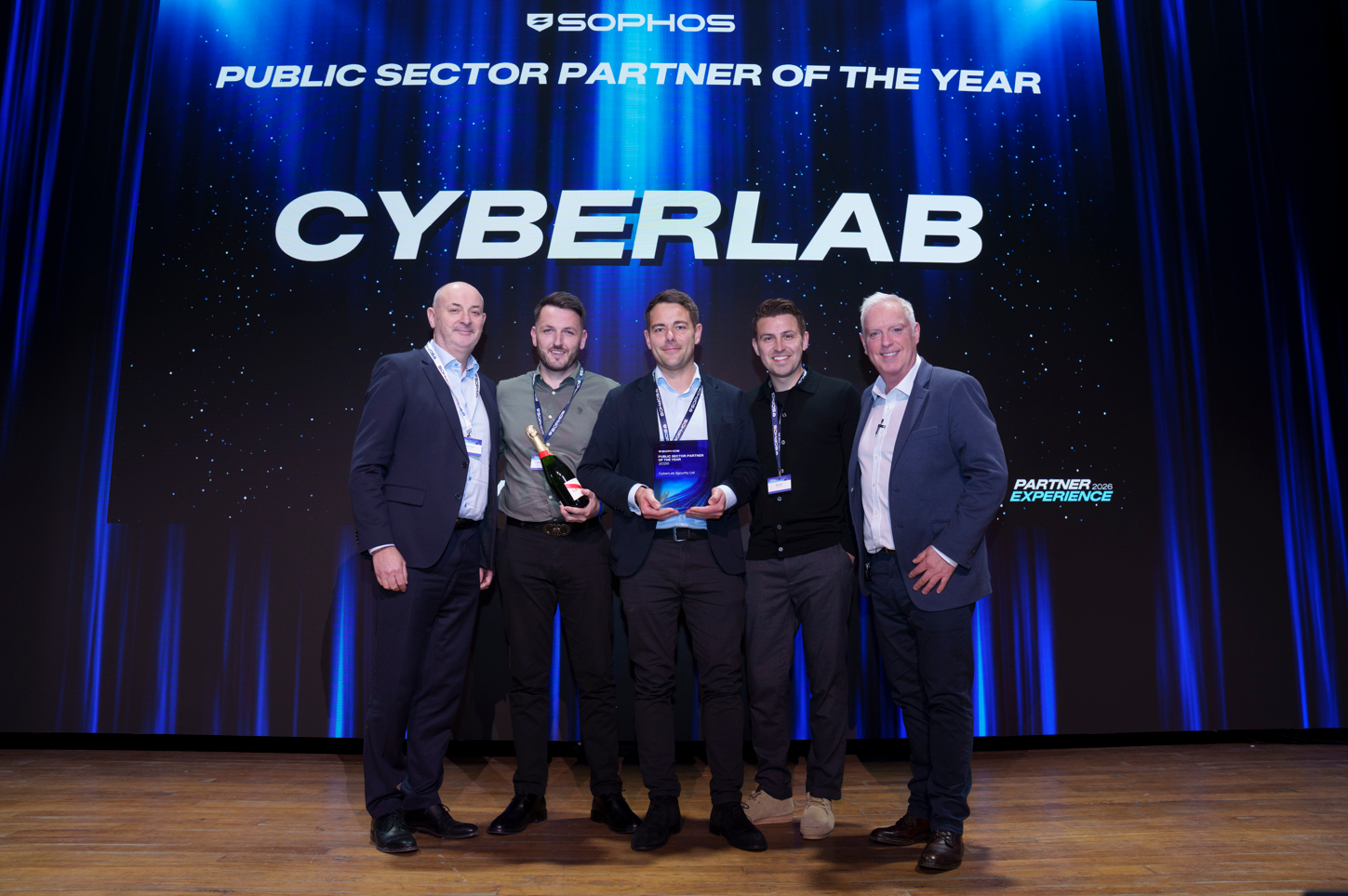
CyberLab Named Sophos Public Sector Partner of the Year 2026
CyberLab Named Sophos Public Sector Partner of the Year 2026 and Achieves Sophos Titanium Partner Status
CyberLab today announced it has been named Sophos Public Sector Partner of the Year 2026, and has achieved Titanium Partner status in the Sophos Partner Program. The two recognitions, awarded back to back, mark a significant milestone in CyberLab’s long-standing partnership with Sophos and confirm CyberLab’s position as one of the UK’s leading cyber security partners for public sector organisations.
Together, the award and the Titanium tier recognise CyberLab’s consistent performance, deep technical expertise, and proven track record of delivering measurable security outcomes for customers across the NHS, central government, local authorities, and the wider UK public sector.
A Double Recognition for CyberLab and Sophos
The Sophos Public Sector Partner of the Year award celebrates the partner that has had the greatest impact on protecting public sector organisations over the past year. Titanium is the highest tier of the Sophos Partner Program, reserved for a select group of partners who demonstrate the deepest commitment, capability and customer outcomes across the Sophos portfolio.
CyberLab now sits in both groups: recognised for excellence in a single sector, and elevated to top-tier status across the partnership as a whole.
CyberLab supports more than 60 NHS Trusts and works alongside central government, blue light services, local authorities and the higher education sector. Sophos technology, delivered as a managed service by CyberLab’s UK consultancy team, underpins much of that work.
Sophos Public Sector Partner of the Year 2026
The Public Sector Partner of the Year award recognises the partner that has delivered the strongest outcomes for UK public sector organisations over the past twelve months. The judging criteria considered the breadth and depth of customer protection, the technical sophistication of the deployments delivered, and the partner’s ability to convert Sophos technology into measurable defensive value for the organisations they support.
Public sector cyber security is uniquely demanding. The threat landscape is unrelenting, budgets are tight, and the cost of a successful attack is borne by patients, citizens and frontline services, not just by an IT function. CyberLab’s award win recognises a year of work delivered against that backdrop, including incident response engagements, managed detection and response rollouts, penetration testing programmes and Cyber Essentials certifications across the public sector.
“Winning Sophos Public Sector Partner of the Year is recognition of the work our team puts in every day to protect public sector organisations across the UK. It is not easy. The threat landscape does not stop, budgets are tight, and the stakes are high.
Our partnership with Sophos goes beyond reselling, and this award reflects that. At CyberLab, our mission is protecting the nation, business and people, and this is exactly what that looks like in practice. I could not be prouder of what the CyberLab team has achieved.”
– Gavin Wood, CEO at CyberLab

Sophos Titanium Partner Status
Alongside the award, CyberLab has been elevated to Titanium Partner status in the Sophos Partner Program. The Sophos Titanium tier is reserved for a select group of partners who demonstrate consistent performance, deep technical expertise, and a strong track record of delivering impactful security outcomes for customers.
As a Titanium Partner, CyberLab gains enhanced alignment with Sophos on strategic opportunities, access to advanced resources, and recognition as a top-performing partner within the Sophos ecosystem. For CyberLab customers, that translates into tighter engineering alignment with the Sophos product and threat-intelligence teams, prioritised access to new capabilities, and a more direct route into Sophos’s elite incident response and managed detection and response services.
“Recognizing partners who consistently deliver exceptional value to customers is central to our partner strategy. Our Titanium partners represent the highest level of commitment, expertise, and performance, and we’re proud to work alongside CyberLab to help organizations strengthen their cybersecurity posture and achieve better outcomes.”
– Chris Bell, Senior Vice President of Global Channel, Alliances and Corporate Development at Sophos

What This Means For Our Customers
The combined effect of the award and the Titanium tier is straightforward: CyberLab customers benefit from a closer, deeper and more responsive relationship with Sophos.
In practice, that means:
- Faster routes into Sophos MDR. Sophos’s Managed Detection and Response service is built on a 24/7 elite analyst team backed by Sophos’s threat-intelligence capability. CyberLab Titanium status gives customers a more direct line into that service, including expedited onboarding and tighter integration with CyberLab’s UK consultancy team.
- Deeper engineering alignment. Titanium partners work more closely with Sophos product and engineering teams on capability roadmap, threat hunting techniques, and customer-specific deployment patterns.
- Recognised public sector specialism. Public sector customers benefit from a partner that Sophos has formally recognised as the leading delivery team in that sector. This matters when the threat actor is sophisticated, the data sensitive, and the deadline tight.
- A broader Sophos portfolio, delivered as a managed service. CyberLab delivers the full Sophos portfolio, from endpoint and firewall through to email security and managed detection and response, wrapped in CyberLab’s own UK-based consultancy and 24/7 support function.
How CyberLab Partners with Sophos
CyberLab’s relationship with Sophos goes far beyond reselling. CyberLab delivers Sophos technology as a fully managed cyber security service, supported by an in-house team of CREST-, CHECK- and NCSC-accredited consultants.
That includes:
- Sophos MDR: 24/7 managed detection and response, delivered with Sophos’s global analyst team and overlaid with CyberLab’s UK consultancy.
- Managed Security Support: ongoing health, tuning and posture management of the Sophos estate.
- Posture Assessment: independent assessment of how well a Sophos deployment is configured against current threats.
- Penetration Testing and Red Teaming: validation of how a Sophos-protected estate stands up under realistic adversarial pressure.
- Consultancy: strategic advisory on architecture, migration and ongoing operations.
This combination of accredited consultancy, managed service, and a top-tier vendor partnership is what sits behind the Public Sector Partner of the Year award and the Titanium tier.
How CyberLab Supports UK Public Sector Cyber Security
CyberLab is one of the UK’s most experienced cyber security consultancies in the public sector.
Specifically:
- We support more than 60 NHS Trusts across the UK
- We are a CREST-, CHECK- and NCSC Cyber Advisor-accredited consultancy.
- We are an IASME-approved certification body for Cyber Essentials and Cyber Essentials Plus, with more than 1,500 certificates issued to UK organisations.
- We provide managed detection and response on Sophos MDR, backed by a UK-based service team.
- We deliver hands-on penetration testing, red teaming, posture assessment and incident response.
- We work directly with public sector procurement frameworks and understand the operational realities of frontline services.
The award and the Titanium tier are independent recognitions of that work, awarded by the vendor whose technology underpins much of it.
“We needed to find a way to meet very tight budget constraints. Of the suppliers we spoke to, only CyberLab demonstrated what we felt was a genuine desire to engage with us to reach a workable solution for both parties. I’d recommend CyberLab not just for their expertise in the whole cyber security area, but for their personalised and professional approach.”
– Mark Smith, Server Support Manager at Nottingham City Council

How CyberLab Executed Targeted Attack Simulations in Financial Services
Simulating Real‑World Attacks to Strengthen Financial Services Security
Financial services organisations operate in one of the most heavily targeted sectors globally. As threat actors continue to evolve their tactics, techniques and procedures, traditional security testing alone is no longer enough to provide confidence.
This case study explores how a leading UK financial services organisation partnered with CyberLab to validate its cyber defences through Red Teaming and targeted attack simulations, providing real‑world assurance that security controls, people and processes could withstand modern attack techniques.
Why Financial Services Are Prime Targets
Banks, lenders, building societies and financial services providers remain highly attractive to cyber criminals and advanced threat actors due to:
- High‑value financial data and assets
- Complex, interconnected digital environments
- Strict regulatory and compliance requirements
- Heavy reliance on customer‑facing digital services
Attackers increasingly combine technical exploitation with social engineering, targeting both systems and people. This makes realistic attack simulation a critical component of modern Cyber Security strategy.
About the Organisation
The organisation is a leading UK financial services provider, serving thousands of customers and members nationwide. Operating within a highly regulated environment, it has built a strong reputation based on trust, service excellence and regulatory compliance.
As part of an ongoing digital transformation programme, the organisation recognised that maintaining a resilient Cyber Security posture was essential to protecting customer data, financial assets and brand reputation.
To gain independent assurance of its security maturity, the organisation engaged CyberLab to conduct advanced offensive security testing aligned to real‑world attack scenarios.
How Are Cloud Services Treated Under the Updated Cyber Essentials Requirements?
The Business Challenge Financial services organisations face a dual challenge: enabling digital innovation while ensuring robust protection against increasingly sophisticated threats.
This organisation operated several business‑critical systems, including:
- Customer‑facing web and mobile banking platforms.
- Internal systems supporting lending and mortgage processes.
- Externally exposed infrastructure supporting digital services.
Any compromise could have resulted in:
- Unauthorised access to sensitive customer data.
- Operational disruption.
- Regulatory scrutiny and financial penalties.
- Long‑term reputational damage.
The organisation needed confidence that its preventative, detective and responsive controls would perform effectively under real attack conditions.
Why Red Teaming Matters in Financial Services
Unlike traditional penetration testing, Red Team exercises simulate the behaviour of genuine threat actors over an extended period.
For financial services organisations, Red Teaming helps to:
- Validate security controls across people, process and technology
- Test detection and response capabilities, not just prevention
- Identify gaps that only emerge during multi‑stage attacks
- Provide evidence of security maturity to regulators and stakeholders
This approach supports regulatory expectations around resilience, continuous improvement and proactive assurance.
The CyberLab Approach
CyberLab delivered a multi‑layered offensive security engagement, tailored to the organisation’s threat profile and risk priorities.
Red Team Exercise >
A multi‑week Red Team exercise simulated advanced attack techniques commonly used against financial institutions.
This included:
- Open‑source intelligence gathering
- Targeted spear‑phishing campaigns
- Assessment of user awareness and susceptibility to social engineering
- Attempts to gain initial access and escalate privileges
The objective was to mirror real‑world attacker behaviour and assess how effectively the organisation could prevent, detect and respond to an active threat.
External Infrastructure Testing >
CyberLab specialists conducted penetration testing across the organisation’s externally exposed infrastructure, assessing:
- Network‑level weaknesses
- Misconfigurations Vulnerabilities that could be exploited for unauthorised access
This testing helped identify technical gaps that attackers could leverage as entry points into the environment.
Web and Mobile Application Testing >
In‑depth testing of customer‑facing web and mobile applications was performed, aligned to the OWASP Top 10 where applicable.
Testing focused on:
- Authentication and authorisation controls
- Application logic flaws
- Data handling and exposure risks
Both automated and manual techniques were used to uncover issues that could impact customer trust and service availability.
The Outcome
The targeted attack simulation provided the organisation with clear, independent validation of its Cyber Security controls and overall resilience.
Key Outcomes
Validation of Cyber Security Controls
The organisation gained assurance that existing controls could defend against realistic attack scenarios.
Identification of Vulnerabilities
Technical and human‑centric weaknesses were identified, including areas susceptible to social engineering and control gaps that required attention.
Enhanced Security Posture
Actionable findings enabled targeted improvements to defensive controls, monitoring and incident response capabilities.
Clear Remediation Guidance
Comprehensive reporting provided prioritised recommendations, allowing efficient and effective remediation aligned to risk.
Key Takeaways for Financial Services Leaders
- Red Teaming provides insight that traditional testing cannot
- People remain a critical attack vector alongside technology
- Regulators increasingly expect evidence of realistic testing
- Continuous offensive testing supports long‑term resilience
Conclusion
Through an ongoing partnership with CyberLab, this financial services organisation continues to take a proactive approach to Cyber Security.
Regular Red Teaming and offensive testing enable the organisation to adapt to an evolving threat landscape, strengthen defences year on year and maintain the trust of customers and stakeholders.
By combining deep financial services expertise with real‑world attack simulation, CyberLab helps organisations protect what matters most: their people, their data and their reputation.

Cyber Essentials May 2026 Update: What Businesses Need to Do to Pass Danzell
What the Cyber Essentials Requirements for IT Infrastructure v3.3 and the Danzell Standard Mean for Your Business
Cyber Essentials continues to evolve to reflect the realities of modern Cyber Security. From 27 April 2026, all new Cyber Essentials assessments are being assessed against Danzell (The new IASME standard based on Requirements for Infrastructure v3.3), introducing more rigorous expectations around cloud security, authentication and patching.
This update is more than a routine refresh. It reflects how organisations now operate, with cloud first services, remote working and increasingly sophisticated commodity threats firmly in scope. For businesses planning certification or renewal after May 2026, understanding these changes early is essential.
This guide breaks down what has changed and, more importantly, what practical steps organisations should take to remain compliant and resilient.
We’ve awarded over 1,500 Cyber Essentials and Cyber Essentials Plus accreditations
Why is Multi Factor Authentication now an automatic failure requirement under Cyber Essentials Danzell?
One of the most significant changes in the Danzell standard is the automatic failure of Multi Factor Authentication when not enabled if available.
Where MFA is supported, whether it is free, bundled or paid for, it must be enabled for all users. Failure to do so will now result in an automatic fail.
What this means in practice
Organisations must:
- Audit all user accounts across email, cloud platforms and administrative portals
- Enable MFA consistently, including for privileged and administrative users (where separate accounts should be in place)
- Remove legacy authentication methods that bypass MFA
This change improves accountability and dramatically reduces the risk of credential based attacks, which remain one of the most common causes of breaches.
How are Cloud Services treated under the updated Cyber Essentials requirements?
Under Danzell a new definition has been added ‘any cloud service that stores or processes organisational data is now in scope’. This removes previous ambiguity around excluding Software as a Service platforms.
Practical considerations for business
You should now:
- Ensure a complete inventory of cloud services in use and maintained in accordance with the updated definition
- Apply Cyber Essentials controls consistently against the updated inventory
- Ensure access controls, MFA, firewalls, malware protection and patching responsibilities are clearly defined with suppliers.
This change reflects how critical cloud services have become to day to day operations and ensures security controls keep pace.
What do the new Cyber Essentials scoping rules mean for devices and services?
The previous concepts of “untrusted” or “user initiated” devices have been removed.
The new rule is straightforward: If a device or service owned by the organisation connects to the internet, or manages internet connected data, it is in scope.
Why this matters
This clarity reduces misinterpretation during assessments and ensures organisations take a more holistic view of their environment. Laptops, mobile devices, servers and cloud platforms should all be considered equally when applying controls. BYOD devices should also not be forgotten when accessing organisational data or services.
All legal entities applying must be listed on your Cyber Essentials application.
Can I exclude systems?
Excluded networks must be clearly detailed in new Danzell scoping statements for any partial scope assessments.
How have Application Development requirements changed in Cyber Essentials v3.3?
The scope formerly referred to as “Web Applications” has now evolved into Application Development.
This aligns Cyber Essentials with the UK Government’s Software Security Code of Practice, increasing focus on:
- Secure coding principles
- Timely patching of applications and frameworks
- Managing vulnerabilities throughout the development lifecycle
Guidance for development teams
Organisations involved in application development should:
- Document secure development practices
- Keep third party libraries up to date
- Demonstrate how vulnerabilities are identified and remediated
- This change reinforces that security must be built in, not bolted on
Why is Passwordless Authentication being encouraged by Cyber Essentials?
While not yet mandatory, the Danzell standard actively promotes passwordless authentication such as passkeys and FIDO2 authenticators.
Why organisations should take notice
Passwordless authentication:
- Reduces reliance on weak or reused passwords
- Improves user experience without sacrificing security
- Aligns with the long‑term direction of secure identity management
Adopting passwordless methods now can simplify future compliance and strengthen overall security posture. For further information IASME guidance should be consulted.
What are the changes for Cyber Essentials Plus under Danzell?
No selective remediation:
Sample 1: If high or critical vulnerabilities are detected by the approved scanning tool in the first sample – a mandatory retest (scanning) with new sampled devices is required (Sample 2).
Sample 2: Random sample of devices which had detected vulnerabilities (high or critical) older than 14 days. If the same vulnerabilities are detected as those from Sample 1 a CE+ fail report is issued and CE certificate revoked by IASME.
- If new or different high or critical vulnerabilities (older than 14 days) are detected this will result in an advisory being noted on the CE+ report and a CE+ Pass awarded.
Assessment rules:
Point in time assessment: All version and system information must be supported and meeting the criteria on the certificate issue date.
- Systems must be supported on certificate issue date, not just submission date.
- Version information should be within the 14-day window for patching if build numbers are provided.
Director declaration: now includes ongoing compliance responsibility.
What are the new Backup and Recovery expectations under Cyber Essentials v3.3?
Whilst not required, backup and recovery have received increased emphasis but are highly recommended by IASME.
Organisations should ensure that backups are:
- Robust and documented
- Protected from unauthorised access
- Regularly tested to ensure recovery is achievable
- If automatic backups are available, you should consider turning them on.
Practical steps to take:
Businesses should review:
- Backup frequency and retention policies
- Offline or immutable backup options
- Evidence of routine restore testing
This ensures organisations are better prepared to recover from ransomware or other disruptive incidents.
When does the Cyber Essentials Danzell standard come into effect and what is the deadline?
There is a critical timing consideration for organisations planning certification.
- Assessments set up before 27 April 2026 will follow the previous Willow standard
- Assessments initiated on or after this date must comply with Danzell Standard
For some organisations, this presents a short‑term opportunity. For most, however, preparing for the new requirements is the more sustainable approach.
How can organisations prepare for Cyber Essentials certification after May 2026?
The Danzell update raises the bar, but it also brings clarity. Organisations that take a proactive approach will find that these changes not only support compliance but meaningfully improve resilience.
Key preparation steps include:
- Reviewing MFA and account separation coverage across all systems
- Bringing all cloud services into scope
- Rigorous system wide patching in line with 14-day requirements, implementation of patching tools
- Updating asset inventories and scoping assumptions
- Strengthening backup and recovery processes
- Aligning development practices with secure coding standards
- Mobile device management for both organisation owned devices and BYODs is strongly advised.
How can CyberLab support your Cyber Essentials journey post-May 2026?
Navigating updated Cyber Essentials requirements can be complex, particularly for organisations with growing cloud environments.
CyberLab supports businesses through:
- Cyber Essentials readiness assessments
- Practical remediation guidance
- Ongoing Cyber Security strategy aligned to evolving standards
If you are planning Cyber Essentials certification or renewal after May 2026, now is the right time to act.

How Not To Hit The Headlines in 2026: What Recent Breaches Have Taught Us
What Recent Breaches Teach Leaders about Modern Cyber Risk
In 2025, we saw some of the most recognisable brands in the UK and beyond hit the headlines for all the wrong reasons.
Cyber attacks cost the British economy billions each year and the impact is felt far beyond the organisations that fall victim. When a major business is disrupted, the ripple effects reach suppliers, partners, and entire sectors of the economy.
In a recent webinar, Sales Director Adam Myers was joined by CTO Ryan Bradbury to unpack four major breaches – Marks and Spencer, Co-op, Jaguar Land Rover and Oracle – and what they reveal about the evolving threat landscape.
For IT leaders, CISOs and boards, the lessons are clear; cyber security resilience in 2026 is not just about the right tools; it is about removing blind spots, strengthening human behaviour, and maintaining continuous visibility.
When Trust Assumptions Break, Attackers Walk Straight in
Across all four incidents, one shared truth stood out. Attackers are not only trying to force their way through hardened perimeters, they are also exploiting small gaps in identity, communication, and process.
Rather than relying on malware or brute force, threat actors impersonated employees, targeted pressured help desk teams, and leveraged stolen credentials. These tactics work because they exploit human behaviour and the real-world pressures teams face.
For leaders, this reinforces the importance of a cyber security culture where teams feel confident to pause, challenge and verify – and where processes are stress tested, not just documented.
1. Marks and Spencer: Social Engineering at Scale
Generative AI is changing the game. Is it helping defenders more than attackers? Dive into the risks, opportunities, and real-world impact of AI on cyber security.
Dave Mareels, Senior Director of Product Management at Sophos, joins the podcast to explore how generative AI is reshaping the cyber threat landscape.
2. AI and Human Defenders Working Together
The April 2025 M&S breach began with attackers impersonating employees to a third-party IT provider. Attackers acquired passwords through social engineering, bypassing normal checks, and enabling them to move laterally to access data before launching ransomware.
This incident highlights a reality many leaders recognise. Even with the right technical controls are in place, people under pressure can unintentionally override them. It is why traditional one-off training is no longer enough.
Organisations now need continuous security awareness programmes, realistic phishing simulations, and tabletop scenario testing to prepare teams for high-pressure decisions.
Cyber Security Tabletop Exercises

Turn incident response planning into a focused, hands‑on exercise.
Combine a posture assessment with phishing simulations, Live Hack demo, and a HackRisk.ai scan in an engaging tabletop session for your leadership team – followed by an executive‑ready report and action plan.
Not role‑play. Real data. Real insight.
2. Co–op: When a Pattern Becomes a Playbook
Just weeks later, Co-op faced a near identical social engineering breach. Attackers reused the same techniques because, simply, they work. This reflects a broader trend where criminal groups increasingly share successful approaches, leaked credentials and intelligence, creating an economy built on repetition.
For CISOs and leaders, this means resilience requires continuous reinforcement. Training cannot be quarterly. Help desk teams cannot rely solely on process. Identity verification cannot rest on assumptions that someone “sounds legitimate”.
The point is not to blame teams, but to support them with clear processes, role-specific training, and communication channels that make it easy to raise suspicions early.
3. Jaguar Land Rover: The Hidden Cost of Unknown Exposures
The major August 2025 breach at Jaguar Land Rover was triggered by stolen credentials and allowed attackers to cause a full production shutdown. The real issue wasn’t one single vulnerability, but a chain of exposures that went unnoticed.
Many organisations still lack full visibility of their internet facing assets or whether their credentials have already leaked. By the time a breach becomes visible, attackers may have been conducting reconnaissance for months.
This is where continuous attack surface monitoring, dark web intelligence and automated reconnaissance become essential. Annual assessments may provide a snapshot into security, but modern attackers exploit the other 364 days too.
4. Oracle: A Zero–Day that Exposed Global Organisations
October 2025 saw attackers exploit an unpatched zero-day vulnerability in Oracle’s eBusiness suite, affecting major organisations across the globe. This incident reinforces a tough truth; even highly mature organisations can be vulnerable when assets are not fully inventoried and internet facing systems are not continuously assessed.
For boards, this underlines the value of visibility as a strategic investment. You cannot protect what you cannot see.
What all these Breaches Have in Common
Across all four incidents, one theme appeared again and again; these breaches didn’t stem from a single technical failure. They were the result of gaps between people, process and technology.
Leaders should consider three strategic priorities:
- Strengthen human resilience
Modern attacks target behaviour as much as systems. Regular tabletop exercises, redteam engagements and realistic training programmes help teams think clearly under pressure. - Remove visibility blind spots
Unknown assets, exposed credentials and unmonitored suppliers are now among the most common root causes of major incidents. Visibility is no longer a technical function, but aboard level priority. - Treat cyber security as a continuous journey
Pointintime assessments are valuable, but insufficient. Continuous scanning, dark web monitoring, and real-time risk tracking help organisations act before attackers do.
Services like Sophos MDR provide expert-led 24/7 threat hunting, detection, and response capabilities to automatically block 99.98% of threats.
How HackRisk Supports Leadership Decision-Making
Our HackRisk platform is supporting leaders in building proactive security strategies.
Its six interconnected security modules are designed to provide the visibility and continuous oversight the modern threat landscape demands.
Together, these insights create a security picture leaders can confidently act on. It is the difference between reacting to incidents and preventing them.
Only 13 percent of UK businesses assess cyber risks within their immediate suppliers and just 8 percent assess their wider supply chain. Yet, as the Oracle case study shows, devastating breaches now originate through partners long considered low risk.
HackRisk’s Supply Chain Security tools allow organisations to invite suppliers, review their cyber posture, assess accreditations, issue onboarding questionnaires and even run financial credit checks, all in one place. For boards and CISOs, this brings clarity to an area traditionally full of fragmented data and manual chasing.
Final Thoughts for Leaders
As Ryan concluded:
“Organisations are not failing because they are ignoring cyber security. They are failing because they cannot see where it is quietly breaking”.
– Ryan Bradbury, CTO at CyberLab
Attackers are patient. They observe. They exploit moments where process meets pressure.
Your defences must do the same. Identify blind spots, strengthen your people, and invest in continuous visibility. These are the steps that prevent your organisation from becoming the next headline.